
The Biggest Mistake an Art Buyer Can Make
No. This not overpaying.

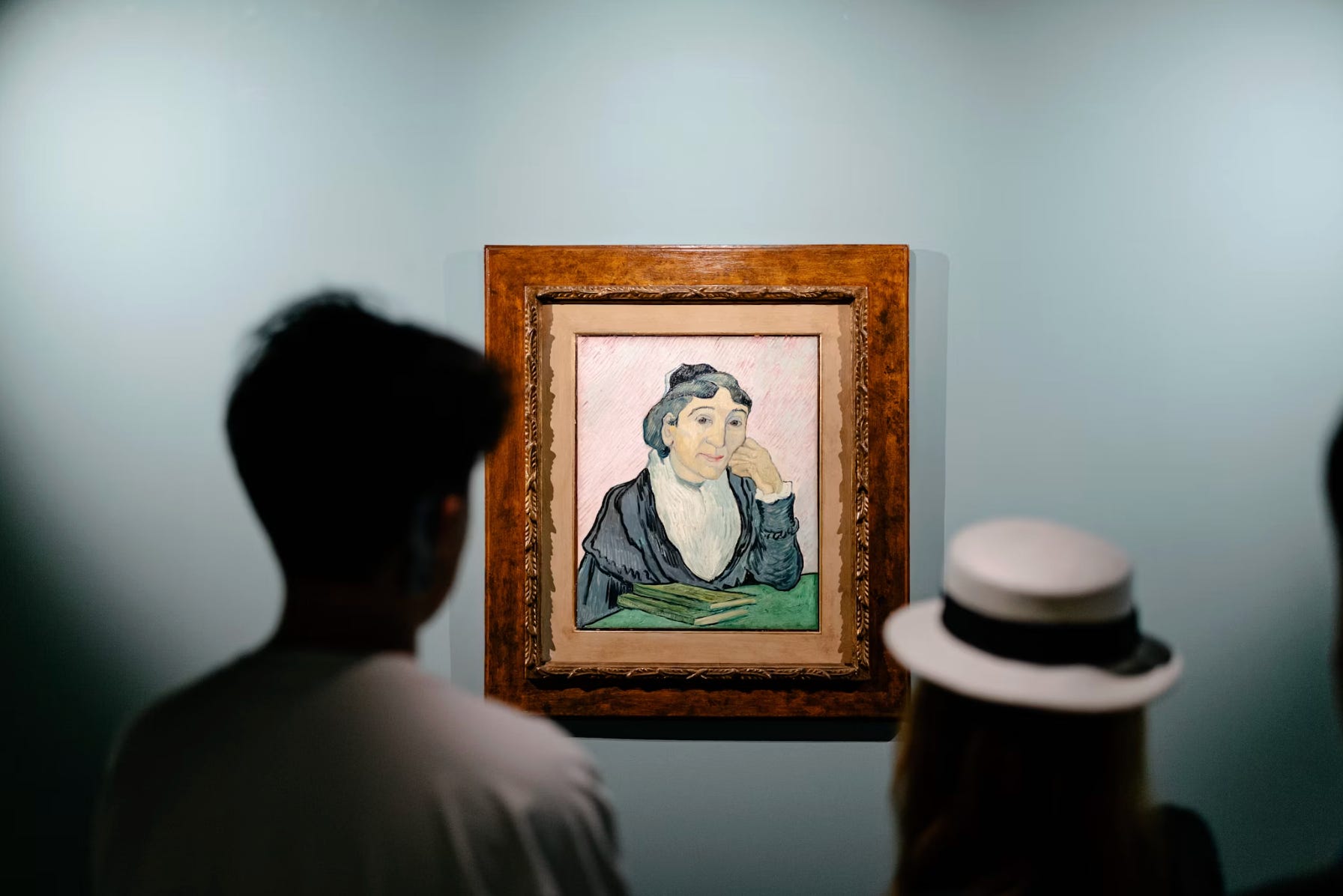
Photo by Tommao Wang, Unsplash.
The biggest mistake an art buyer can make is not overpaying. It is not choosing the wrong size, the wrong medium, or even the wrong artist. For someone buying original art to live with, rather than to hold as an investment asset, the biggest mistake is not trusting their own taste.
This is especially true for new collectors. Often, a private question appears once you realise you genuinely want a work: How do I know if this painting is actually good? Is it “worth loving”?
And this is where the biggest disappointments start.
According to the Hiscox Online Art Trade Report, 94% of art buyers named emotional benefits as a key motivation for purchase. People may speak about price, provenance, and market context, but the first impulse is often more intimate: the work has to do something to them. This feeling cannot be rationally explained, and even less can it justify the sometimes high price of a worthy original painting. So we begin to devalue it, searching for justification for our suddenly swollen feelings toward the painting.
Is it too beautiful? Too emotional? Too simple? Too strange? What if the artist is not known enough? Not represented by a gallery? No auction history, museum exhibition, recognized collectors, or polished CV? What if tomorrow someone more competent looks at the work and says, “Are you crazy for buying this?”
At that moment, the question changes. You no longer ask, “What do I feel when I look at this work?” You ask, “Am I feeling correctly? Am I right to like this? Or do I simply not understand art well enough?”
Collector Anxiety
Among art-market professionals, there is a commonly used term for this phenomenon: “collector anxiety”.
It is usually described in practical terms: the fear of overpaying, buying at the wrong moment, misunderstanding provenance, choosing the wrong gallery, or purchasing an artist without a future market.
But the deepest layer of collector anxiety is not financial. It is personal.
The major fear is buying the “wrong” art.
Price can be rationalised. You can compare dimensions, medium, career stage, exhibition history, demand, and recent sales. You can ask whether the number makes sense. Taste cannot be rationalized in the same way.
A buyer’s taste is not a decorative preference detached from life. It forms over years through memory, class, education, love, longing, shame, aspiration, loneliness, beauty, fear, rooms one has lived in, books one has read, places one has left, and versions of oneself one still hopes to become. Taste exposes us far more than budget does. It shows what kind of beauty disarms us, what kind of strangeness feels true, what colours calm us, what images return us to something we may not have named for a long time.
And saying, “I like this artwork”, can sometimes feel dangerously close to saying: “This is what I need right now. This is me”.
That is why taste can be more frightening than price. We are often unsure of ourselves and our choices, especially when it comes to something as honest as art. Taste in art exposes us, making us vulnerable to judgment and longing for external approval.
The Art Market Offers Expertise. We Buy Permission.
The art market understands this vulnerability very well. Don Thompson, in The $12 Million Stuffed Shark, quotes Howard Rutkowski, formerly a specialist at Sotheby’s and later a director at Bonhams, who put it bluntly: “Never underestimate how insecure buyers are about contemporary art, and how much they always need reassurance.”
Much of the market is built around that need. Gallery representation, fair participation, auction history, museum acquisitions, waiting lists, institutional interest, press coverage, the right collectors, advisors, and price all function as external supports for the anxious buyer. The more expensive the work, the more elaborate the architecture of reassurance.
This does not mean that such signals are meaningless. Expertise matters. Context matters. A serious gallery can help build an artist’s career responsibly. A good dealer can explain why one work is stronger than another. An informed advisor can help a collector understand whether the price is reasonable, whether the work belongs to an important series, whether the practice is coherent, and whether the purchase is being made under transparent conditions. No one should buy art in a complete vacuum, especially when real money is involved.
But all these rituals have to support your choice.
We often believe we are looking for knowledge when we are actually asking for sanction. Expertise helps us see better; permission relieves us from the responsibility of seeing for ourselves. Expertise gives tools. Permission does something else. It tells us: now you may want this because someone else has already approved it.
Why Unrecognized Artists Frighten New Collectors
This is why buying art from an unrecognized or not-yet-institutionalized artist can feel psychologically difficult. When an artist has been accepted by the system, the buyer is protected. The gallery becomes a shield. The auction record becomes an argument. The museum exhibition becomes insurance. Even if the work does not fully move you, it can still be defended: this is an important artist; they are represented by a serious gallery; people are already buying them; the market has spoken.
In other words, the buyer is not alone. Someone else has already looked first.
But when an artist has not yet reached that moment — before institutional recognition, a strong gallery, auction visibility, or market validation — the collector occupies a more exposed position. There is less to hide behind. To buy the work is to say: I see value here before it has been officially confirmed for me. “I can hear the sound of violins, long before it begins…”. Remember? This is it.e real moments of collecting. Not the purchase of value once it has been fully explained, but the ability to recognize life in a work before the market has made it safe.
One survey found that 58% of collectors are more motivated by the subject matter and story behind an individual work than by the artist’s background or career. Yet when anxiety enters, the hierarchy often reverses. The story that moved us suddenly feels less important than the CV that can protect us.
This does not mean romanticizing obscurity. An unknown artist is not automatically important, and an emotional reaction is not enough on its own. But the fear of buying outside established validation reveals something essential: the collector is not only evaluating the artist. They are also confronting their own capacity to see.
The most interesting collections have rarely been built by people who only bought what was beyond dispute. Herbert and Dorothy Vogel, a New York couple — a postal clerk and a librarian who became legendary collectors despite modest incomes — built one of the most admired collections of conceptual and minimalist art in the United States by buying directly from artists when much of the work they collected had little broad commercial appeal. Remembering an early acquisition of Sol LeWitt, Herb Vogel said: “I knew something was new. I didn’t know how good or bad it was; I just knew it hadn’t been done before.”
That is not the language of market certainty. It is the language of perception before validation.
The Worst Mistake Is Not Buying the Wrong Work
New collectors often imagine the worst mistake is buying the wrong artwork: a work that does not increase in value, an artist who never breaks through, something too decorative, emotional, naïve, or distant from the established conversation. But for someone buying art for the home, the more intimate mistake is different. It is walking away from the work that genuinely moved them and buying the one easier to justify.
A work with better language around it. Easier to explain at dinner. One that comes with a stronger institutional frame. One that looks more intelligent than your desire.
And then it hangs in your home.
Every day.
This is especially serious because many buyers are not purchasing art for storage, speculation, or distant resale. Data show that 71% of collectors buy art to decorate their homes, while 67% say they buy it to inspire their daily lives. If the work is meant to live with you every day, buying something you do not truly love is not a small compromise. It is a daily one.
An unloved painting at home is very heavy. At minimum, it may look wrong. At most, it will ruin your daily life because it will drain you visually and psychologically. A desired, beloved work hanging on the wall at home can nourish us and change our lives.
Where Real Collecting Begins
This is why mature collecting begins before the purchase.
It begins before the invoice, certificate, framing, shipping, and even before the moment of decision.
It begins when an art buyer stops being ashamed of their own response to an artwork and asks themselves: “Does the work still hold my attention after the first encounter? Can I imagine living with it, not merely displaying it?”
Taste in art begins, first of all, with accepting yourself and your preferences. With self-trust. And then it becomes knowledge and self-development. We look at a beloved work, and even years later, it can reveal something new each time — about us, about itself, about the artist.
Through beloved art, we learn, grow, change, make mistakes and accept mistakes, but first of all — we remain ourselves.
The worst mistake an art buyer can make is not buying the wrong work…
It is betraying the one that truly moved us. Betraying ourselves.
Happy collecting.
Yours,
The Paragone.