
How Does Having an Original Painting at Home Help to Decrease Cognitive Exhaustion?
We leave work, but our nervous system doesn’t. How can art help?

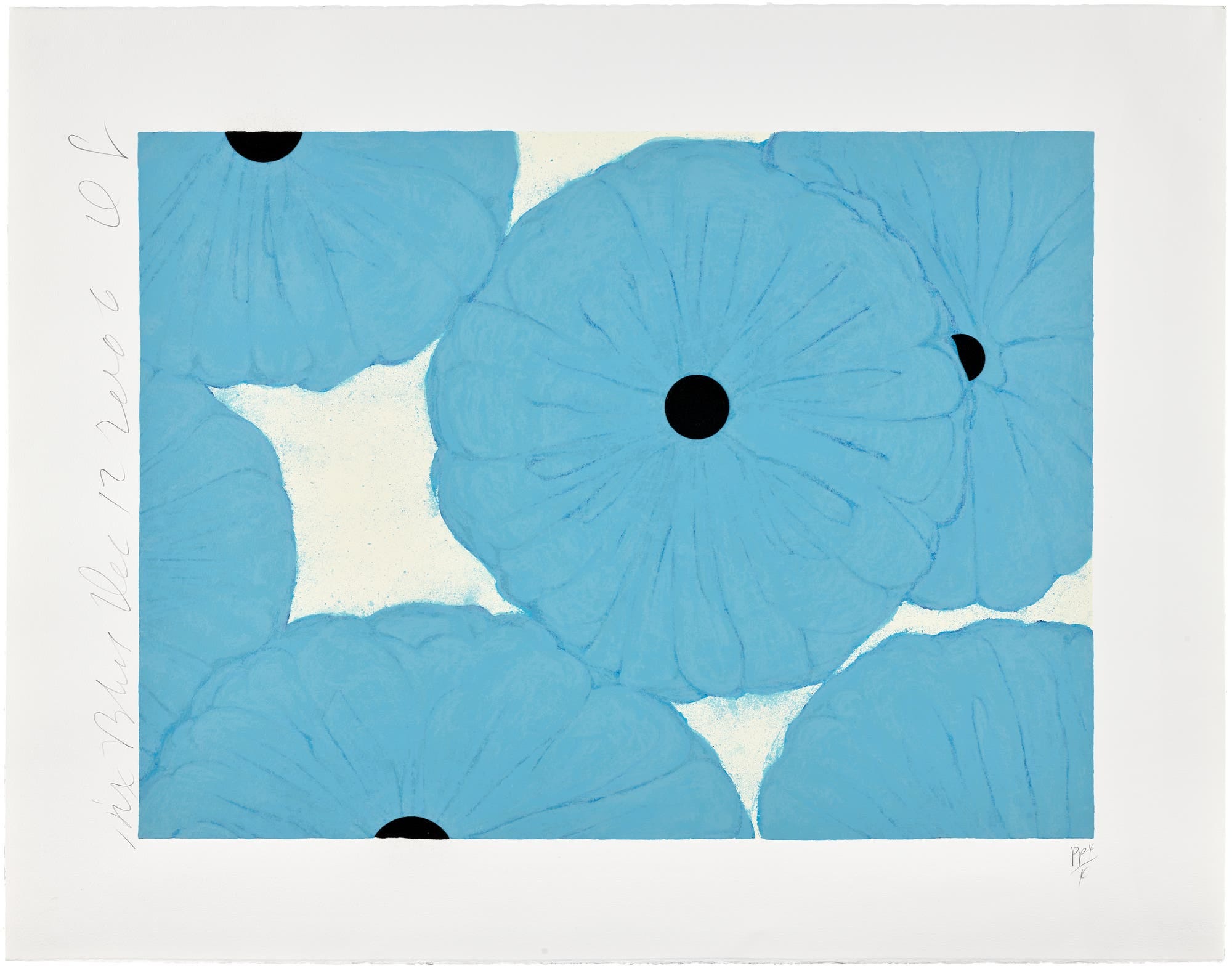
Six Blues by Donald Sultan, 2006.
The Crisis of Chronic Tiredness
We are a constantly tired generation. We get tired of work, the news, others' expectations, and our own standards. We even get tired of describing why we are so tired.
Yes, this seems to be what adult life is, and it requires a state of near-constant cognitive tension.
This is especially true for professionals whose work is tied to continuous problem-solving, rapid decision-making, and measurable outcomes. The mind learns to stay alert because almost everything around it requires an immediate, effective response.
When the human nervous system remains in this state of hyper-alertness without adequate decompression, its natural adaptive resources inevitably deplete. A person may still appear productive, competent, and in control, while internally feeling increasingly fragile, irritable, detached, or unable to recover properly.
Even after the laptop is closed, our minds remain switched on, unable to relax. This is one of the quiet crises of modern professional life: the body leaves work, but the nervous system does not.
The Limits of Standard Wellness Modalities
When facing chronic exhaustion, the instinctive response is often to treat the brain like an isolated machine requiring maintenance. High-achieving professionals frequently construct rigorous self-care routines: meditation applications, therapy, exercise, supplements, sleep tracking, and pharmaceutical support.
These tools can be valuable and, for many, necessary. However, they often focus on the mind as if it exists separately from the physical surroundings to which it returns every evening. This is where something vital is missed: the visual environment.
The visual environment matters because the psyche does not recover in isolated abstraction.
Even if we have had a very effective meditation or therapy session, it is always time to return to the physical world.
And since the eyes are among the most critical centers for gathering information and shaping our psyche, the visual surroundings play a vital role — what the eyes repeatedly perceive becomes part of the emotional climate of daily life. For instance, a cluttered, sterile, or visually aggressive environment can keep the nervous system in a state of low-grade tension, while a coherent, emotionally resonant environment can signal safety, continuity, and rest.
If the home environment lacks sensory depth, the eye has nowhere to rest. The brain remains trapped in the same rigid visual vocabulary that drives its fatigue during the working day: screens, notifications, documents, dashboards, artificial light, and flat digital surfaces.
The Human Need for a Safe Harbor
In environmental psychology, a restorative place refers to a physical environment that helps the body shift from vigilance to recovery. [1]
When the workday is defined by invisible metrics, abstract pressure, and digital overload, the human brain suffers from a form of sensory deprivation. It does not need more stimulation; it needs a different kind — slower, richer, quieter, and more embodied.
A home cannot merely serve as a functional holding space between working hours. At its best, it becomes a psychological environment that helps the nervous system return to itself. This is where the presence of authentic, physical art shifts into a meaningful tool for emotional restoration. Not as a replacement for therapy or a medical cure, but as part of a daily environment that helps the mind soften, reorient, and recover. Let’s explore how looking at art can lower stress levels and why original art is better for mental health than digital prints.
The Neurobiology of Visual Restoration
Integrating art into a living space introduces several psychologically restorative qualities:
The Phenomenon of Soft Fascination
Environmental psychologists use the term “soft fascination” to describe a state in which attention is gently held by something that does not demand problem-solving. This is entirely different from professional attention, which is sharp, instrumental, and goal-oriented, constantly asking what must be fixed, answered, or completed. [2]
A painting asks for another kind of attention. When observing it, the eye moves across the physical surface: the thickness of brushstrokes, the subtle layers of pigment, the movement of color, and the interaction of light and shadow. The mind is engaged but not forced; it is invited to stay without being required to perform. This looking can be deeply restorative because it allows the brain to remain awake without being under pressure. The mind does not always need to be emptied; sometimes it needs to be held by something that asks for nothing in return.
Neuroaesthetics and Emotional Reward
The field of neuroaesthetics studies how the brain responds to beauty, form, color, and aesthetic experience. When a person looks at art that genuinely resonates with them, the response is emotional, bodily, and deeply regulating, creating pleasure, recognition, calm, curiosity, or a sense of being returned to oneself. [3]
This internal chemistry serves as a distinct biological reward system, yet not all rewards are the same. Rewards triggered by digital notifications or professional validation are sharp, short-lived, and tied to external performance, often carrying anxiety.
In contrast, the reward of living with art is slower and becomes part of the emotional rhythm of a home. A cherished artwork functions as a reliable, screen-free source of visual and emotional nourishment — there in the morning, after a difficult call, or when the day has been too much. Over time, the work becomes not just something one owns but something one returns to, serving as an emotional anchor for the psyche.
Tactile Grounding and Sensory Reconnection
When professional output consists mostly of strategy, code, presentations, messages, or digital documentation, the psyche can become disconnected from the physical world. Artwork acts as a focal point of tangible reality. It is a dense artifact of human presence: hours of attention, gesture, physical labor, and emotional intensity held in canvas, paper, pigment, wood, or fabric.
The mind registers this differently from a screen image. An artwork carries imperfection, texture, weight, and trace, reminding the viewer that not everything meaningful is frictionless, editable, or instantly replaceable. A recent study by researchers from King’s College London and the Courtauld Institute of Art found that viewing original artworks was associated with a 22% reduction in cortisol, the body’s key stress hormone, compared with 8% for participants viewing reproductions. [4]
For a nervous system trained to live in digital abstraction, this physicality is grounding. It creates a visual and emotional boundary between the world of work and the world of recovery, quietly asserting: the digital workspace has ended. A different reality begins here.
Thus, if you are regularly exposed to stress and constant cognitive tension, start with one artwork your eye wants to return to.
Not necessarily the fashionable one. Not necessarily the expensive one. Just the one that visually gives you what you need right now: peace, energy, tenderness, courage, silence, or a sense of inner order.
Choose the work that changes your state at home.
In our upcoming articles, we will explore in detail how to choose art for the home to meet different psychological needs — and how to live with art under one roof happily ever after.
Take care.