
The Beginner’s Guide to Buying Art (Without Feeling Like an Imposter)
6 Essential Tips to Start Collecting Good Art as a Beginner

There is a distinct, high-end anxiety that comes with the desire to buy art. In any other luxury market, having a few thousand euros makes you a celebrated client. In the art world, it often makes you feel like an uninvited guest at a very exclusive party.
If you have ever stared at a blank wall in your living room, opened Artsy, and immediately closed it out of sheer intimidation, you are not alone. The system is designed to feel opaque. But buying your first artwork, or starting a collection, is not an exam you need to pass. It is actually a very personal, intimate, and deeply rewarding ritual. You are buying art you will live with and see every day.
We structured the process of starting your art collection so that it feels both pragmatic and less intimidating.
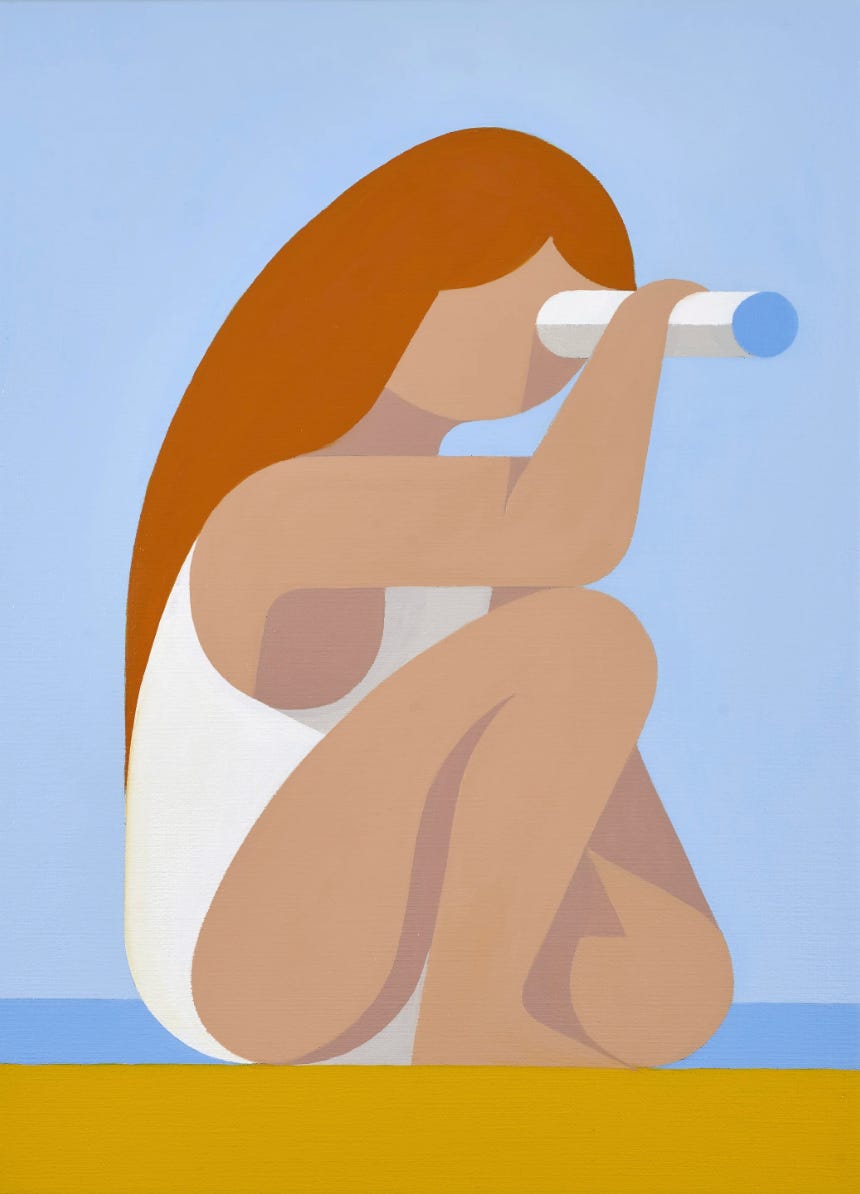
Fisher Suite (Observer) by Leonhard Hurzlmeier, 2022
1. Define Why You Want to Buy Art
Before you look at a single canvas, you need to be honest with yourself about your motives. Are you buying because your new apartment has echoing, empty white walls? Are you looking for an emotional anchor — something that changes the energy of the room every time you walk in? Or are you quietly hoping this piece will fund your retirement in fifteen years as a financial asset?
There are no wrong answers here. As we explored in our previous guide, What Kind of Art Collector Are You?, understanding your dominant motivation is the only way to avoid buyer’s remorse. If you are an emotional collector, do not let an art advisor talk you into a cold, minimalist investment piece. Define your “why” first, and let it act as your financial shield.
2. Train Your Eye: Look at Too Much Art
Training your eye is necessary because it helps you understand what genuinely attracts you and holds your attention. It is not about “forming your taste” according to what you should like. Visual discovery — of both good and bad art — helps you understand your preferences more clearly and recognize what truly makes your heart beat faster.
You will begin to notice what you are drawn to. Do you respond more strongly to a particular material? Are you more attracted to form or color? Minimalism or expression? By looking at different kinds of art, you also begin to know yourself better.
It is wonderful if you have the opportunity to visit museums and galleries, but online discovery works well too. We will explain where and how to search for art below.
3. Shift Your Mindset From “Art Lover” to “Collector”
An art lover looks at a painting and thinks, “That’s beautiful.”
A collector looks at a painting and asks, “What do I feel — and why?”
Shifting into a collector’s mindset means looking more deeply and more consciously. Who is the artist, and what is their story? How does this specific work speak to your personality and your life? How will this piece become part of your everyday life at home?
Remember: you are no longer simply buying an individual object to fill a gap above the sofa. You are curating a personal visual library. You are building a collection you will interact with every day, and it should become a resource for the reason you started collecting in the first place.
4. Set Your Financial Framework
The biggest mistake beginners make is not setting a clear financial boundary. Without a framework, you will either buy nothing out of fear and exhaustion or overspend on overhyped nonsense.
Defining your comfortable spending range, most importantly, helps you focus your search. In the contemporary art market, price brackets usually work roughly like this: under $5,000, under $10,000, under $50,000, and above.
Let us reassure you right away: price is usually not a direct indicator of the quality of the work. We will discuss art pricing in the next essay, but for now, it is enough to know that for under $5,000 you can find a work no less powerful than one priced at $100,000.
Once you understand your approximate budget, you can search more deeply within that range. This will significantly increase your chances of finding what you need without compromising. So decide on your number, and stick to it.
5. Ignore the Trends
The contemporary art market thrives on artificial hype.
Galleries love to create waiting lists and synthetic scarcity around “trending” young artists to encourage panic-buying among new collectors.
Artists shoot reels to generate attention through likes.
Platforms like Artsy and Saatchi release their “curated lists.”
Sometimes all these promotional efforts are justified, but often they do not reflect the actual quality of the work. And even if the art is genuinely good, it may simply not be for you.
Ignore the noise. Trends are short-lived, and the artists heavily marketed today are often resold on the secondary market tomorrow. If a piece does not challenge you, comfort you, or spark a conversation, it does not matter how much hype surrounds it.
Trust your eye and your gut feeling, and buy for longevity.
6. Start the Hunt
Now that you are equipped with the essential recommendations of a beginner collector, it is time to start the hunt.
Your hunting strategy depends first of all on the price range you have chosen. In short, the higher the price — especially from around $10,000 and above — the more useful it becomes to involve an intermediary, such as a gallery, art dealer, or auction house, because legal and transactional details can become more complex. If your budget is around $5,000, buying independently is often completely reasonable.
Look for graduating MFA student exhibitions. Use social media to follow independent curators. Scout digital platforms not necessarily to buy immediately, but to track which independent artists are building consistent, authentic bodies of work. When you find an artist whose vision aligns with yours, buy directly or work with small, transparent galleries that actually respect your budget.
Building a collection is a slow game. Take your time, trust your taste, and remember: the art you live with should make you more.
Next week, we will look more closely at how to hunt well, the legal details of buying art, and how to negotiate a discount.
Happy collecting.