
Why do we need more art in our daily lives right now?

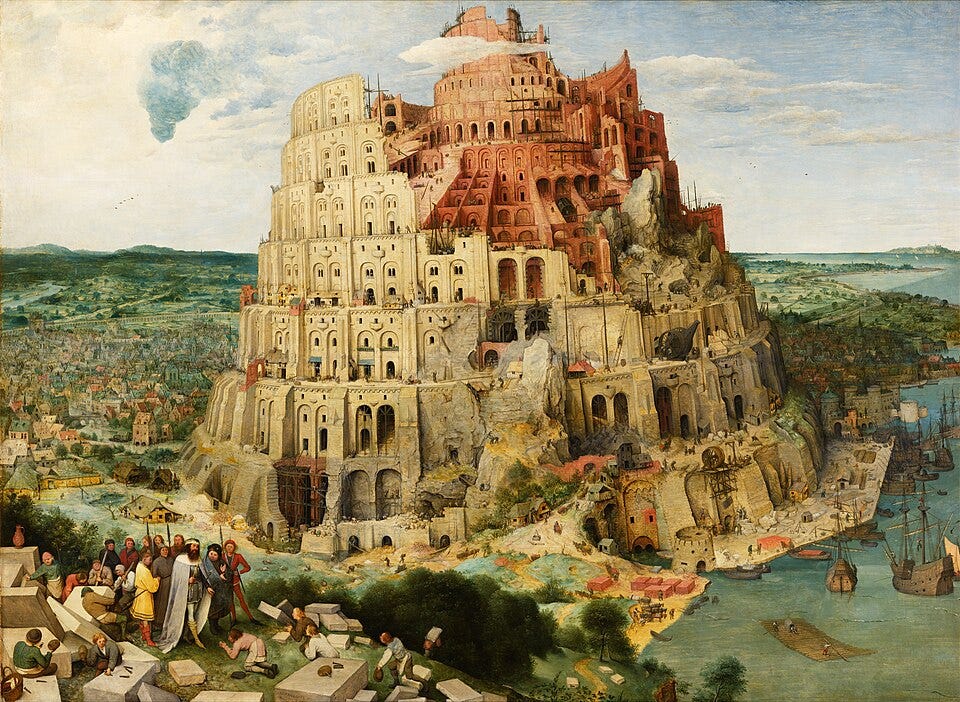
Pieter Bruegel the Elder’s The Tower of Babel (1563)
Let’s not rub salt into the wound — you are probably already well aware that the modern world now resembles the Tower of Babel more than ever. We are building our castles higher and higher, already reaching into space, but along the way, we are losing the skill of human contact, not only with others but with ourselves.
What does art have to do with this, you may ask?
During the COVID pandemic, attendance at physical museums plummeted due to lockdowns, while virtual tours, online collections, and art lectures experienced explosive growth. During other periods of crisis, for instance, after 9/11 in the US, many museums also noted increased attendance. In moments of individual or collective stress and adversity, art becomes a place to process these experiences and find at least temporary relief.
Why does this happen?
Why, when we look at art, do we stop breathing, or our eyes fill with tears, or, on the contrary, we feel a surge of energy and trembling excitement…?
Art critics or art historians are unlikely to be able to answer these questions for you. Such reactions are too visceral, too personal, to be framed by historical facts or explained through context, technique, or genre. It feels more like a psychological response than an appreciation of mastery.
When our external and internal worlds descend into chaos, and the future seems uncertain, our intuitive pull toward art follows deep psychological patterns. What are we unconsciously looking for?
Restoration of Balance and Stability in Chaos
In times of uncertainty, the psyche seeks order where it can still be found.
The museum itself, with its familiar route, silence, and schedule, becomes a model of an ordered world.
And a painting with a clear, resolved composition provides the brain with the very visual and semantic anchor it desperately needs.
This is an act of mental self-soothing through structure.
Relief and Containment of Unbearable Emotions
Our own emotions in a crisis can feel intolerable because they are formless and all-consuming.
Art gives them form and boundaries. It transforms personal anxiety, grief, or anger into an object that can be observed from the outside.
This is my pain; this is what it looks like. I still feel it, but it’s no longer just inside me. I can look at it from the outside, and it already hurts a little less.
This is the psychological mechanism of containment, where the artwork acts as a safe vessel for feelings.
Searching for an Exit and a Different Perspective
When we feel trapped, we look for a window into another reality. Art is precisely that window.
It doesn’t make empty promises that tomorrow will be easier. It shows that “otherwise” is possible in principle.
The tender domesticity in a Vermeer interior, the expansive, untroubled skies in a Constable landscape, or the serene weightlessness of figures in a Raphael fresco — these are alternative worlds that exist here and now.
They remind us: your inner landscape can also be organised according to these — more peaceful, spacious, or sublime — laws.
Restoring Dulled Sensitivity
Routine and chronic stress act as anaesthesia.
We stop noticing shades of colour, the complexity of textures, the subtle movements of the soul. Art becomes a training ground for sensation.
It teaches us again to see and feel, engaging neural pathways abandoned in survival mode. We leave a museum not just with new thoughts, but with renewed organs of perception, capable of finding beauty and meaning even in the small.
Spiritual Growth and Connection to Eternity
Time flows differently in a museum. Next to a portrait painted five centuries ago, our momentary anxieties lose their absolute significance. We feel ourselves part of the long human story — a story of suffering, the search for beauty, inquiry, and overcoming. This doesn’t diminish our personal pain but places it in a different, universal perspective. We are not alone; we are a link in the chain. And this knowledge provides not naive hope, but existential resilience — the deepest and most unshakable foundation possible.
Thus, our encounter with art is a complex, often unconscious act of psychological self-regulation.
When we are in a state of psychological instability, we can use art as a precise tool: for structuring inner chaos, giving form to vague feelings, searching for alternative models of being, rehabilitating our own perception, and gaining spiritual scale.
We truly hope that life will be kind enough to spare you from needing art as a remedy for pain.
But if the moment comes, consider walking into the nearest museum or gallery. Or simply open the Instagram page of an artist who makes your heart tremble.
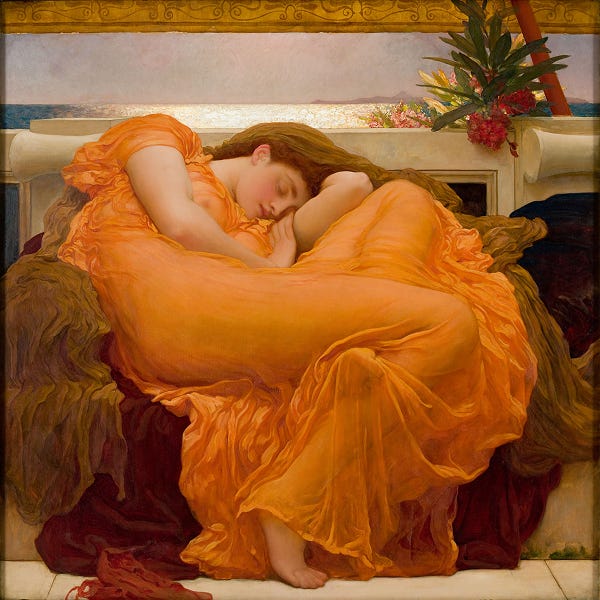
Frederic Leighton’s Flaming June (1895).
Take care.
Really good one...