
Why art prices are hidden — and how to avoid overpaying.
What does "Price on request" actually mean?

Few things are more frustrating when you find a work you fell in love with online or in a gallery than seeing: Price on request.
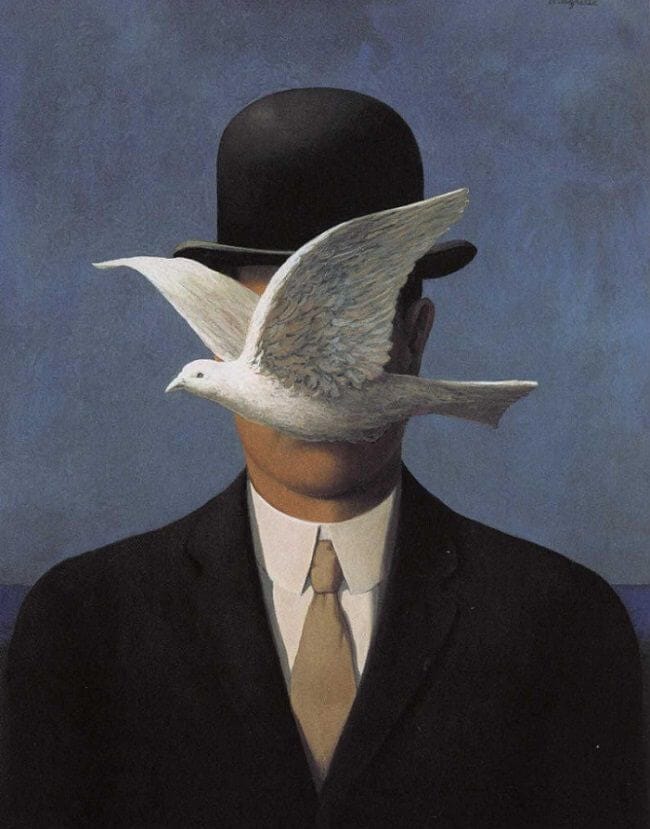
Man in a Bowler Hat, 1964 by René Magritte
This is particularly maddening for a new generation of collectors who have no time and make decisions impulsively — if I like it, I want to buy it right now.
But no. You have to submit an inquiry, wait for a response, and then, when someone finally calls you back, open with: “We would be delighted to know you better!”.
Seriously?
This feels especially absurd in 2025, when even luxury brands have learned to publish six-figure prices without a second thought. But when price mystification is practised around emerging or mid-career artists, where prices are far more accessible, it generates nothing but irritation.
So why does the art world still do it?
Firstly, pricing is sometimes not fixed and depends on a collector’s profile, artist momentum, geography, and demand. Think of it as a light version of a credit score. For galleries, it’s a way to understand how much you’re willing and able to pay.
Secondly, it’s manipulation. In the 21st century, there is still a belief that opacity creates exclusivity. The art world operates on the assumption that hidden prices make art feel like access to a private world — and you must pass an “interview” before the gallery decides at what “individually exclusive price” to sell you the work, as if purchasing a ticket into an elite club. My personal favourite is when they lean in with a mysterious, hypnotic voice: “Several other collectors are also interested in this piece.” So I’m supposed to fight for it? Really?
Just to remind you: we are living in the 21st century, and I want to spend €5,000 on an emerging artist, not €50 million on a Renaissance work of global cultural significance.
So, how to hack the system and avoid overpaying?
1. Ask for the price directly — and ask again.
Say it plainly: you don’t have time, or you simply don’t want to share personal information.
2. Contact the artist directly.
If the gallery contract isn’t exclusive, the artist may be able to sell to you directly. The specific work might not be available — but sometimes you’ll discover something you love even more. And buying directly from an artist is a remarkable experience. That is what real belonging to the art world actually feels like.
3. Don’t confuse Instagram hype with market validation.
Visibility is not the same thing as value. There are at least two ways to inflate a social media following artificially — and in the art world, those followers are often not the audience that matters. If you’re buying for love rather than investment, trust your own eye above all else.
4. Use public price databases before you buy.
Before committing to a gallery price, spend some time researching what the artist’s work has actually sold for at auction (Artnet platform, but with paid access) or check platforms like Artsy to look at the artist’s actual pricing. If a gallery is asking €8,000 for an artist whose average price is €5,000 — that’s a reason to question the gallery’s pricing.
5. Be cautious with hyped artists right now. We’ve usually been discovering an artist through social media algorithms — and often that means the moment has already passed and prices are at their peak. Either wait a few months for the hype to settle, or consider other artists entirely. Trust me: there are hundreds of genuinely talented painters who are worth exploring — ones untouched by the hysteria of likes and shares.
What’s most striking is that despite the art world’s constant rhetoric about needing new collectors, price transparency remains one of the biggest barriers to buying art.
Because of this old-school commitment to hidden pricing, it’s often the artists themselves who suffer most — waiting months for a sale simply because getting a price feels like applying to the CIA.
Challenging this dynamic is in the interest of both collectors and artists equally.
Happy collecting.
I really hate "Price on request" in galleries... It is definitely soooo irritating!