
Tacit Knowledge


A few years ago, I went through the deepest existential crisis of my life (so far).
After fifteen years of building what most people would call a successful career in tech, I walked away. It wasn’t an impulsive decision. It came after years of feeling that I could no longer continue in the same direction, even though I had no idea what should come next. The old “me” no longer fit. The new one hadn’t yet taken shape.
So I went looking for “myself”, and for a “new purpose”.
I read an ocean of books on career change, vocation, and meaning. I watched interviews, listened to podcasts, and worked my way through everything I could find from psychologists, entrepreneurs, and successful creatives on how to discover a new calling.
After spending some time researching, I realized that many of them offered the same advice: find what you love, follow your passion, enjoy the process. Others placed greater emphasis on personal values and meaning, but they all seemed to converge on the same idea: if you don’t enjoy the process, it’s probably not for you.
As someone who tends to approach life experimentally, I decided to test the hypothesis. I made a list of everything I genuinely enjoyed doing — consulting, teaching, photography, painting, building communities, starting a tech company, writing — and, one by one, I tried them all, hoping that somewhere along the way I’d finally land on a new professional identity.
I often enjoyed the process. Sometimes I enjoyed it immensely. And yet, sooner or later, I quit.
It wasn’t for lack of motivation or discipline. It wasn’t because the work stopped being interesting, or stopped aligning with my values. It was interesting. It did align. But at some point, something in me refused to go on further.
I think the main reason was that I’d been taking for granted the idea that loving the process is one of the clearest signs something is truly yours. But it just didn’t work for me, so I set out to explore this question.
The lives of truly extraordinary people tell a different story.
Andre Agassi, one of the greatest tennis players of all time, wrote in his biography (great book, by the way) that he hated tennis — not occasionally or during difficult periods; he hated the game itself all the time, and even his wins exhausted him.
Ernest Hemingway described the process more bluntly:
“There is nothing to writing. All you do is sit down at a typewriter and bleed.”
Charles Darwin spent twenty years revising and postponing On the Origin of Species, endlessly second-guessing himself and describing the work as slow and laborious.
So perhaps loving the process isn’t, after all, a prerequisite for the work of a lifetime.
Art, and painting in particular, makes the case even more forcefully.
Claude Monet — “It drives one crazy”.
We’re used to thinking of Monet as the painter of light and tranquil gardens. His paintings feel like midday dreams, radiating the very ease and pleasure of life itself.
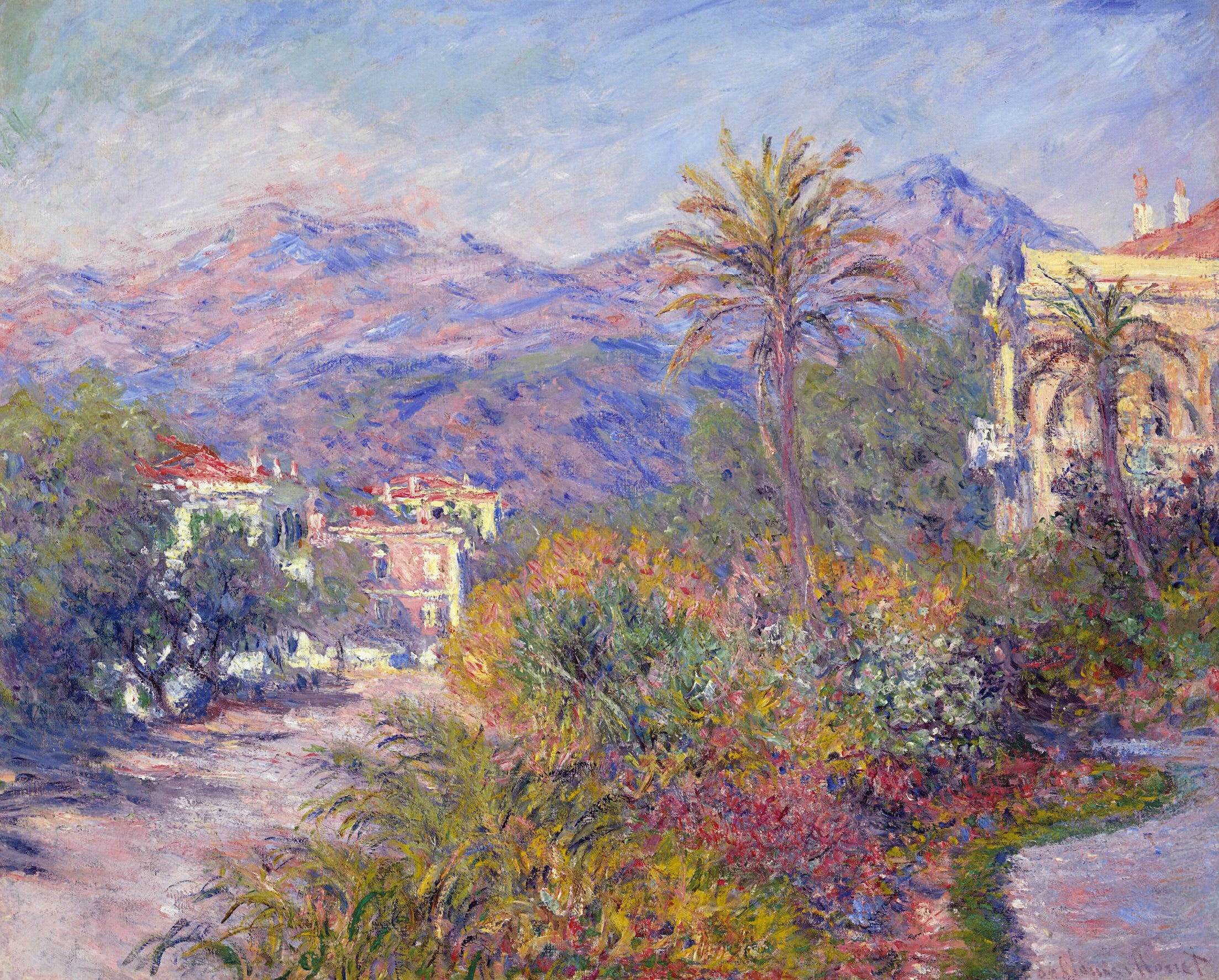
Claude Monet, Strada Romana in Bordighera, 1884
In 1886, Claude wrote to his wife:
“I am weary, having worked without a break all day... how difficult it is to paint!... I can see what I want to do quite clearly, but I’m not there yet... I have fourteen canvases underway.”
Three years later, in 1889:
“I am distressed, almost discouraged... What I am doing is no good... I am very worried.”
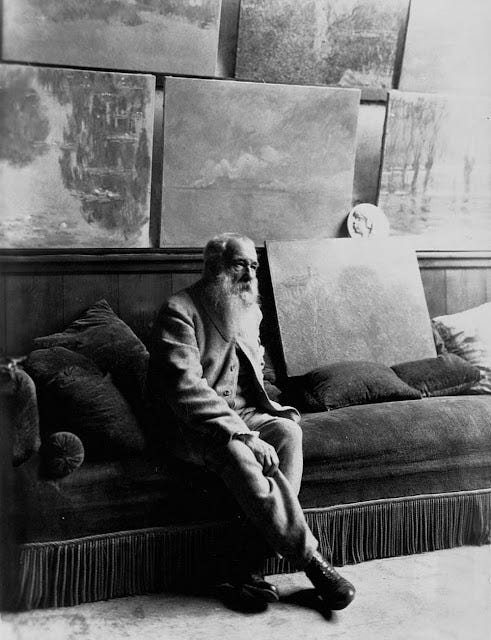
Claude Monet in his studio at Giverny, 1920. Photograph by Henri Manuel.
A year after that, working on the water lilies, he came closer to despair than anywhere else:
“Water... It is a wonderful sight, but it drives one crazy to try to paint it. But that is the kind of thing I am always tackling.”
It drives one crazy. Doesn't sound like he enjoyed the process very much, does it?
And still he kept returning — to the lilies, and to whatever else he was painting obsessively through his life:
Roughly 25 haystacks,
More than 30 views of Rouen Cathedral,
Nearly 250 water lilies.
…and many more.
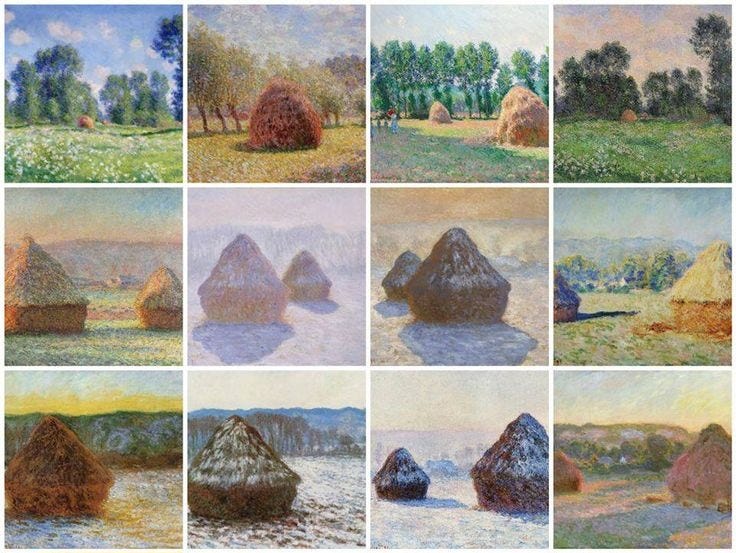
Claude Monet, Haystacks Series at Giverny (1885–1893).
Paul Cézanne — “Painting is damned difficult”.
Cézanne said it plainly:
“Painting is damned difficult — you always think you’ve got it, but you haven’t.”
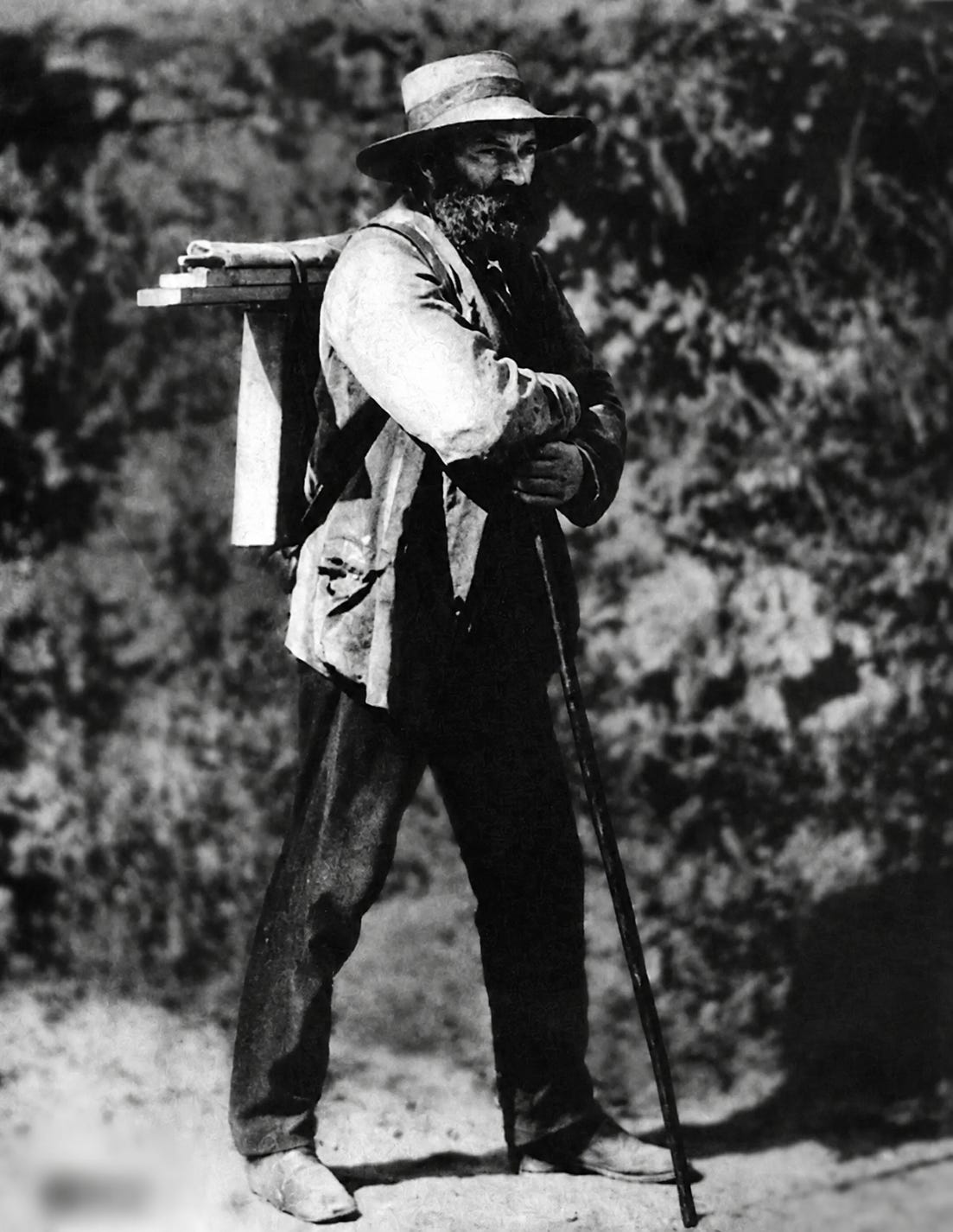
Paul Cézanne on his way to paint outdoors in Auvers-sur-Oise, c. 1874, photographer unknown
His dealer, Ambroise Vollard, who sat for him through 115 sittings, later recalled how “difficult it is to imagine how slow and painful his progress was on certain days.”
Cézanne painted Mont Sainte-Victoire more than 60 times, and I doubt it was simply that he couldn’t think of another subject.
A month before his death, he was still writing to his son:
“The realization of my sensations is always very laborious.”
Even when his place in art history was already secure, he was still struggling with the work itself.
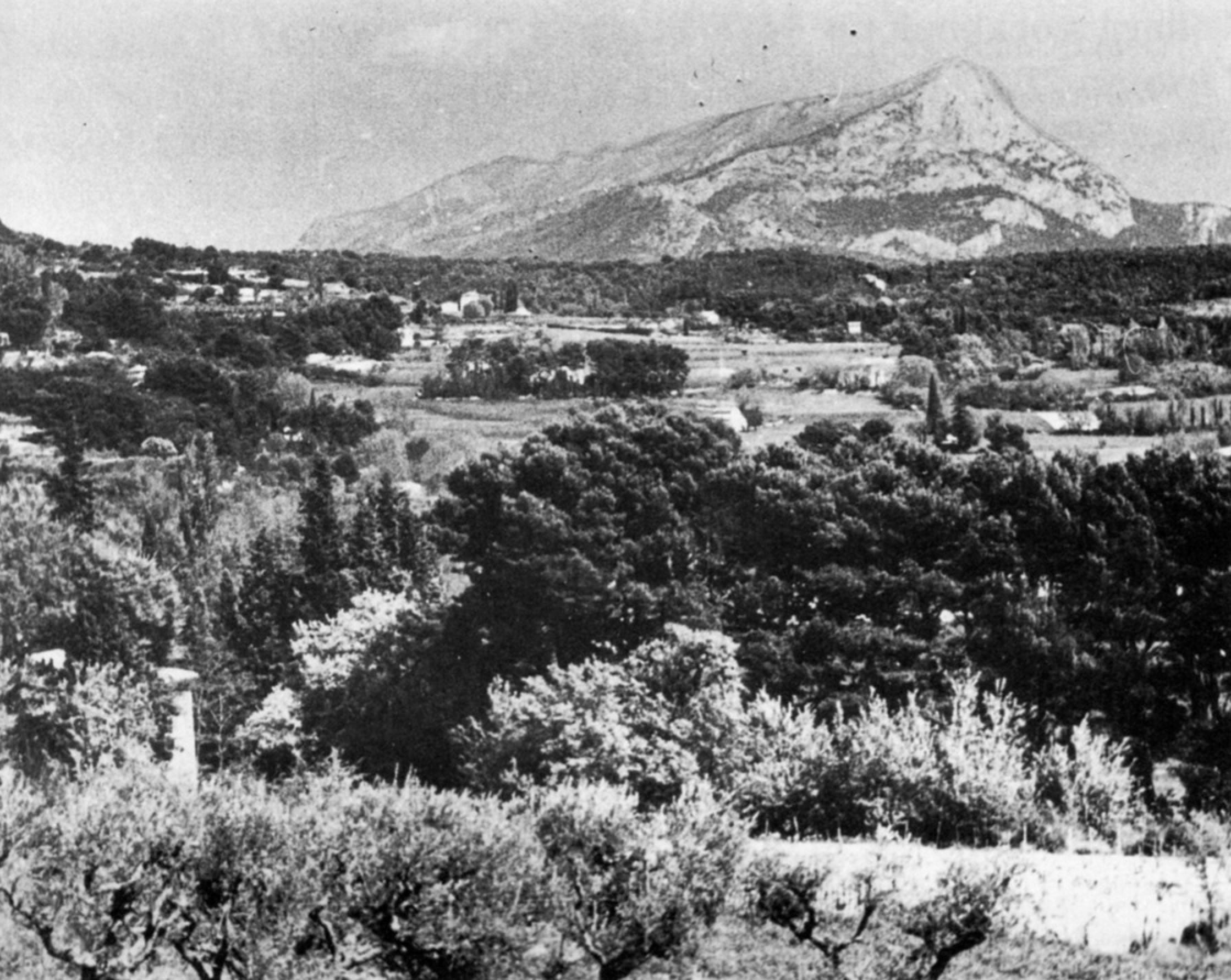
Mont Sainte-Victoire from Les Lauves, c. 1935, photographed by John Rewald
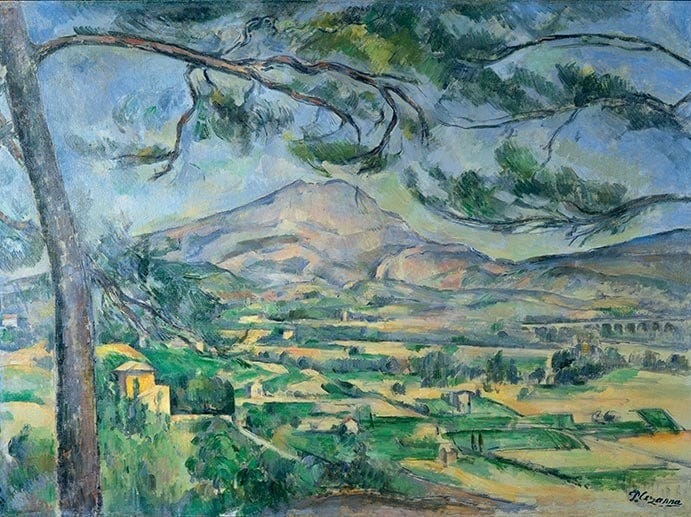
Paul Cézanne, Mont Sainte-Victoire with Large Pine, c.1887
Lucian Freud — “Because they’re so hard”.
Asked once whether he remembered all of his paintings, Lucian Freud gave a wonderful answer:
“Oh yes, because they’re so hard, you see.”
A single portrait could take him a year, sometimes longer; some sitters posed for over a thousand hours.
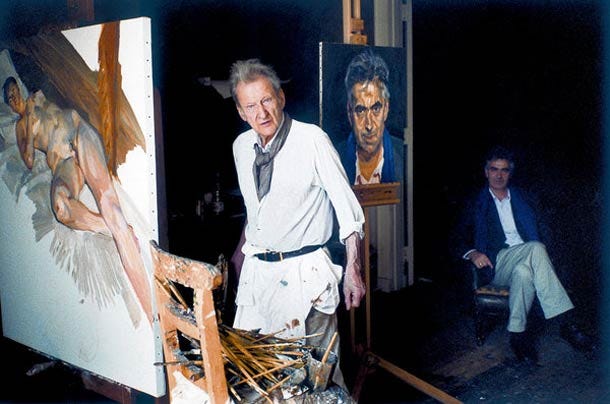
Lucian Freud in his studio painting Bernard-Henri Lévy, 2002, photographed by David Dawson
David Dawson, Freud’s assistant for nearly twenty years, remarked in his interview How Hard Work Kept Freud Fit:
“Seven days a week, every day of the year. He really put the hours in.”
By the time I’d worked through these stories, and recalled several more (Van Gogh among them), it had become hard to believe that the process was easy, or even enjoyable, for them.
So I began to wonder: if the process was so painful, so exhausting, and at times nearly unbearable, what kept bringing them back and going further?
From the perspective of the psychology of art, perhaps what held them was what we might now call the productive neurosis. Psychology has long observed that unfinished things exert a peculiar hold over the human mind.
In the 1920s, psychologist Bluma Zeigarnik discovered that unfinished or interrupted tasks are remembered better than completed ones, and our attention keeps returning to them. The mind seeks closure.
In 1994, behavioral economist George Loewenstein’s Information Gap Theory extends the idea. He suggested that what often keeps us searching and engaged in a pursuit is not the novelty or pleasure of the process itself, but the recognition that there is still something essential we do not yet understand. When we notice the distance between what we already know and what we want to know, that gap produces a kind of cognitive tension.
In 1958, philosopher and scientist Michael Polanyi offered a more philosophical language for the phenomenon of pursuing the unknown. In Personal Knowledge, he argued that some forms of understanding cannot exist before the act of doing; they emerge only through practice itself. He called this tacit knowledge — the kind of knowledge we possess but cannot fully articulate. As he later put it, “We know more than we can tell.”
Perhaps this is why Monet, Cézanne, and Freud kept returning to the same works and the same subjects for years. They were searching for a resolution — an answer they did not yet know, and could not even imagine in advance.
This pattern is remarkably common among artists. Ask almost any painter, and they will tell you that they rarely know what the finished work will look like before they begin. There may be a subject, an idea, or a series of preparatory studies, but the painting itself gradually reveals itself only through the act of painting. Sometimes that process takes years. Sometimes it demands dozens of attempts before the answer finally emerges.
It seems to me that sometimes we have been mistaken in following the paradigm of “loving the process.” Perhaps for some of us the process is not supposed to be “lovable,” but valuable, because it is the only act through which knowledge that does not yet exist can emerge.
This is close to what Rilke had beautifully put decades before Zeigarnik and Polanyi had a name for it.
In Letters to a Young Poet, he wrote:
“Be patient toward all that is unsolved in your heart and try to love the questions themselves…Live the questions now.”
Maybe that’s the better question to ask ourselves, too. Not “Do I love the process?”, but “What keeps me staying?”, or “What question am I still trying to answer?”
Looking back, I think this is why so many of my own experiments came to an end. There wasn’t a question that I truly wanted to answer.
Today, immersed in the history and psychology of art, I still don’t fully know why I’m doing this, or where it’s leading. The research, the writing, the teaching, even the plain administrative work of keeping it all going sometimes, feels so exhausting and genuinely difficult. More than that, I still don’t know exactly what I’m looking for. The Question itself is still unclear.
But I have a feeling I’ll find it here. In this blog. In this essay. In this particular, stubborn commitment. In the struggle itself.
And one day I’ll find not just the question, but the answer.
Or maybe I won’t.
But I believe the process is worth living.
The Paragone is ad-free, AI-free, and written entirely by one loving, passionate human—me. If my work touches your heart, please consider supporting it with a donation to help keep it alive and thriving. If you already do, I am deeply grateful.